


VEJA International
Por Blog SEGUIR
 SEGUINDO
Reality shock
The euphoria of the recent past has given way to a wave of gloom among the inhabitants of Rio. However, the fact is that both the previous over-the-top optimism and the current hangover are wrong




Summertime in Rio is usually a season marked by trends and fashions that highlight the behavior and emotional state of Cariocas (as inhabitants of Rio are called. Memories of this summer – which begins in December in the southern hemisphere and is set to end in two weeks – are far from pleasing. There were mass invasions of the beaches by bands of criminals, a wave of attacks in the Southern Zone, episodes of violence in pacified favelas (shantytowns), garbage accumulated in the streets during the Carnival, traffic chaos brought about by works in the center of the city, with everything made worse by a very high cost of living. So many bad experiences give the impression that the city is suffering from a hangover after the euphoria following its choice to host the Olympic Games in 2016. Therefore, it is only natural that people should feel pessimistic about the future. However, no matter how sincere this feeling might be, it is exaggerated just as it was also absurd to believe that the city would be transformed into a paradise in the blink of an eye. “People usually judge reality by the period they are living in at that moment without putting the facts into perspective. There is no doubt that we have experienced some unpleasant periods in recent months. We are also frustrated with the slow pace of the changes. Nevertheless, there is no doubt that life is much better today than it was five or six years ago,” said Viviane Mosé, a philosopher and psychoanalyst. “The changes we want are complicated and do not occur from one minute to the next.”
To obtain an objective assessment of the real challenges the city faces, VEJA RIO chose six claims Cariocas have often heard — or even said — in recent weeks on issues ranging from the economy to public safety, including traffic and the environment. With the help of specialists, the magazine aims to show which of these claims is myth and which is true based on concrete data such as figures and statistics. The findings can be seen in the following pages and, as the numbers and specialists show, there is no reason for Rio´s inhabitants to fall into depression. Having said that, a lot of work still lies ahead.
Tourism is increasing but some visitors still leave, complaining about the city and the Cariocas
TRUE: The amount spent by visitors increased by US$ 400 million between 2012 and 2014
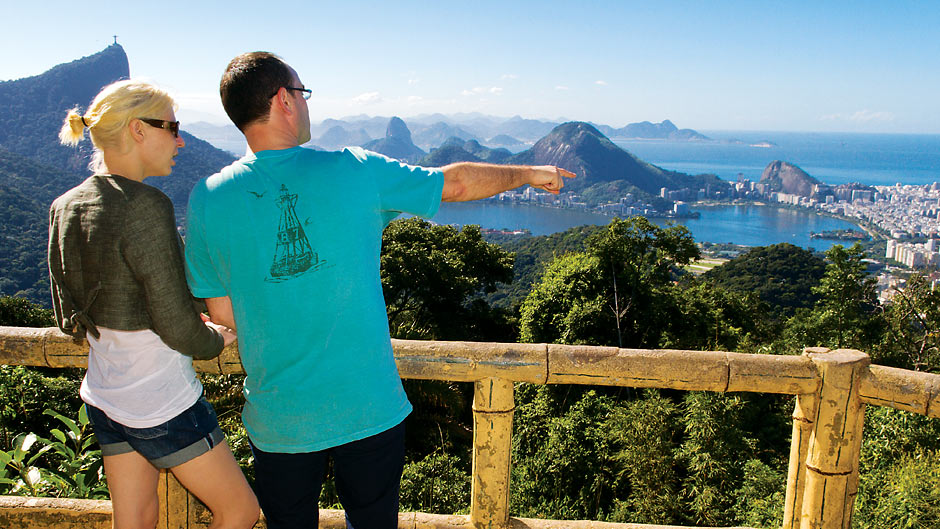 Visitors to the Vista Chinesa (Chinese View): the natural beauty competes with poor service and a lack of structure
If there is one sector that immediately reflected the good phase Rio is enjoying, it is tourism. The city is safer, with growing self-confidence and is enjoying an unbeatable popularity. It has also been flooded by waves of visitors from Brazil and abroad. Rio received 3.3 million people from outside the city towards the end of this summer, 200,000 more than in the same period of 2012. These visitors spent US$ 2.6 billion. The impact on the Rio economy in the period was US$ 400 million more than the previous year. “Rio is obviously one of the most traditional tourist attractions but the World Cup and the Olympics have brought great publicity and the result is there for those who want to see it,” said Antônio Pedro Figueira de Mello, secretary of Riotur.
You only have to look at the growth of the hotel network to see the impact. There are currently 76 accommodation projects underway in different stages of construction that will double the number of beds available by 2016. This is excellent news that will have a direct impact on one of the city´s problems which is the daily hotel rates. “Accommodation in Rio is one of the most expensive in the world as there is a very strong built-up demand. There is no doubt that Rio will receive increasingly more people,” said Andrew Sangster, CEO of the British consultancy Hotelanalist. The problem lies in the way tourists are received. The Tom Jobim airport will still have the air of a bus station before the World Cup. Likewise, there is little chance of any improvement in the poor services provided by stores, restaurant staff and taxi drivers. The culture of swindling visitors who do not speak Portuguese remains strong and the information services continue to offer low quality assistance to foreigners. Being a desirable destination means more than just offering a package of unmatched beautiful locations. People have to be treated so well that they will have an irresistible desire to come back again.
The current escalation of violence could be a setback to gains made in terms of public safety
MYTH: The index of violent deaths fell by 56% between 1994 and 2014
Robberies committed by minors in the Arpoador and Aterro do Flamengo districts. Policemen murdered by gangsters in the Complexo do Alemão favela. Shootouts in the Rocinha and Pavão-Pavãozinho favelas. A series of frightening episodes like these over the last three months raised fears that the spiral of violence of the 1990s was back. The hysteria reached such a degree that a teenager suspected of stealing was tied to a post with a bicycle lock by a group of thugs who tried to enforce justice with their own hands. Similar occurrences have led citizens to believe that the pacification model in the favelas that has been in place since 2008 has gone beyond its breaking point and is beginning to come apart. The response to this concern is that things are not as bad as might be imagined. Although indices show an increase of 9.7% in the number of homicides in Rio over the last 12 months, the current situation is very different from 1994. In that year, violent deaths per 100,000 inhabitants peaked at 64, a rate compatible with countries involved in civil wars. The current rate is 28 murders per 100,000 inhabitants, a high number compared with developed countries but 56% lower than in 1994. “In terms of police strategy, the Police Pacifying Units (known locally as UPPs) are and will continue to be the best response that has been created to combat crime in Brazil. They replace the confrontational mindset, a kind of approach that has failed,” said João Trajano, a political scientist and coordinator of the Violence Analysis Laboratory of the Rio de Janeiro State University. “The UPPs need adjustments, mainly in the investigation area, but the program cannot be regarded as a failure or be dropped.”
The first steps have already been taken in this direction and have begun to show results. The police station in Rocinha, which was set up in 2013, captured a suspect on Tuesday (March 11) believed to have been involved in coordinating attacks on the UPP in the favela in February. Eight men were arrested in Alemão the previous day, accused of killing state policeman Rodrigo Paes Leme. It is a difficult task to reverse the thinking on how to tackle crime which dominated entire areas of the city for decades. Drug traffickers who are used to setting the rules in the communities under their control have been reacting to the loss of their territory, as occurred recently in a shootout with policemen in the Pavão-Pavãozinho favela. “The Carioca has lived with shots, assaults and stray bullets for years and this has left us with a traumatic memory,” said the Security Secretary José Mariano Beltrame.
“When a battle between the police and drug dealers occurs, the tendency is to think that those bad times have returned,” he added. The successful occupations of the Morro Dona Marta favela in Botafogo and Ladeira dos Tabajaras favela in Copacabana, which do not cover large areas and have small populations, created the expectation that this success would be repeated in bigger areas such as the Rocinha and Complexo do Alemão favelas. “We are entering former megacities of crime, areas of chaotic urbanization where it is difficult to carry out patrols. We have to seriously discuss how to urbanize these areas,” Beltrame said. The response to crime today is less reactive and more coordinated which also reflects the changes introduced among the security forces. The situation in Rio may be far from ideal but the Wild West days are gone.
Once the big sports events are over, Rio´s economy will start to decline
MYTH: Rio´s per capita GDP amounts to US$ 15,400, US$ 3,000 higher than the national average
The announcements that the World Cup and Olympic Games would come to Rio de Janeiro raised the city´s profile in an unprecedented way and created great expectations among Cariocas. Pharaoh-like projects were promised that would impact the quality of residents´ lives and boost urban development. Some of these are coming off the drawing board but there are plenty other projects that will remain in the pipeline or gather dust in drawers of the public authorities. With less than 100 days before the World Cup and just over two years to the Olympic Games, a feeling is beginning to gain force that the changes will not be so momentous and the city runs the risk of returning to the economic malaise in which it was stuck for almost three decades. However, the real situation points to a different scenario. “The big events are very important but as they will end on a certain date and time, there is a feeling in the air that everything will go back to the way it was after the party´s over,” said Marcelo Haddad, director of the Rio Negócios investment promotion agency. “People forget that the real driver of Rio´s development – city and state – is the offshore pre-salt oil reserves which will certainly transform our economy“.
The World Cup and the Olympic Games will jointly bring great investments in infrastructure from the federal, state and municipal governments, such as the Metro and the TransCarioca highway. However, it is the oil exploration in the Campos Basin that will determine Rio´s future. By 2017, the state-owned oil company Petrobras will invest US$ 127 billion in exploration. These resources will pass through a chain of hundreds of companies involving sectors as varied as shipbuilding, food, hotels and ports. There is no doubt that Petrobras is currently experiencing a crisis, due mainly to the federal government´s decision to use it for political ends. The aftermath of the implosion of another giant player in the area, Eike Batista´s group, is also very real. Former billionaire Batista´s spectacular failure tarnished the image of Rio´s entrepreneurism. However, the enormous reserves of black gold are still in Rio´s backyard and the price of a barrel of oil has not stopped rising. “The government has taken a series of decisions with its eyes on the upcoming elections. As a result, we are still not taking advantage of the potential in our hands. However, this does not mean that all this wealth that has not yet been exploited has disappeared,” said consultant Adriano Pires of the Brazilian Infrastructure Center. A report by the American credit rating agency Standard and Poor’s (S&P) issued last week gave an idea of Rio´s economic strength. Despite downgrading the credit rating of the country as a whole (from BBB stable to BBB negative), the rating for the city of Rio remained unaltered (BBB stable). The reasons? S&P analysts believe that even with this adverse outlook, the city will pay its debts on time, thanks to its strong economy, good financial performance and flexible budget.
They also cite as an example of Rio´s strength the fact that it has a per capita GDP of US$ 15,400, US$ 3,000 higher than the national average.
The shameful sight of garbage left on the streets during the Carnival could be repeated during the big events
MYTH: The Zero Garbage program led to a reduction of up to 58% in the volume of trash in the streets
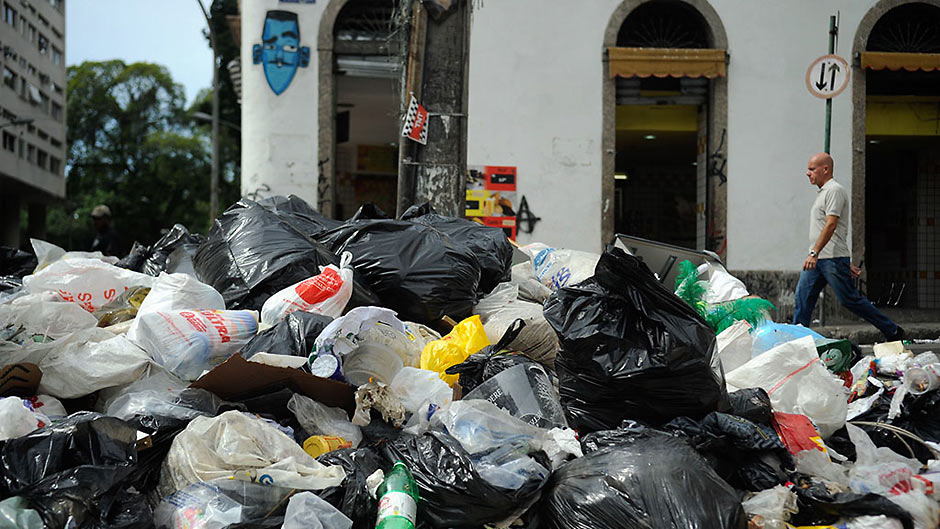 Garbage piled up during the Carnival: the cleaners´ strike was a purely localized problem
The street Carnival is one of the symbols of Rio´s recovery and attracts an average of one million visitors. However, the city´s image was tarnished by this year´s Carnival. A sudden strike called by street cleaners in the middle of the festivities left piles of garbage in the main streets. The pictures caused a shock and were given international coverage, with negative headlines in newspapers and on television channels worldwide, including CNN. With the bad smell spoiling the atmosphere, the idea gained force that the way the city deals with its waste is on the verge of getting out of control. In fact, this was a purely localized episode that does not reflect the progress that has been made in this area. The Zero Garbage program launched in August 2013 has reduced rubbish on the street by 58% by punishing litter louts who do not use public trash containers but throw paper, packaging, cigarettes butts and other items onto the street, with fines ranging from R$ 98 to R$ 3,000. The program has led to 35,000 fines being imposed since it was launched and a battalion of 500 employees, including agents of the city cleaning company (Comlurb) and municipal security personnel who inspect 62 districts and beaches. People have become more attentive to urban cleanliness, as was shown in the repercussions from a video in which the Rio mayor, Eduardo Paes, threw a piece of fruit onto the street in the West Zone.
However, the environmental question in Rio goes well beyond the piles of garbage in the streets. Guanabara Bay, the Barra and Jacarepaguá creeks and sewage spills in areas such as the slopes above the Avenida Niemeyer highway show how far Rio is from meeting the promises made to the International Olympic Committee (IOC) in 2009. The list of tasks the Brazilian government handed over stated that by the time the Olympic flame was lit, 80% of the 16,000 liters of sewage dumped into Guanabara Bay per second would be properly treated. The creek system in the West Zone would be completely dredged and free of domestic waste from the surrounding area. However, 30 months before the competition gets underway, the prospect is disheartening. Only 35% of the sewage produced in the metropolitan region of Rio is currently treated. For example, Recreio, a district that is expanding rapidly, continues to dump 30% of its raw waste into the environment, a figure that rises to 40% in the Jacarepaguá district. “The measures taken until now sound cosmetic. These are emergency solutions that do not solve the problem,” said Paulo César Rosman, professor of coastal engineering and oceanography at the Coppe institute of the UFRJ university.
The road works will not ease the chaotic traffic
MYTH: Line 4 of the Metro will reduce the volume of vehicles between the Barra district and the Center by 40%
Unnerved by the gradual tightening of the stranglehold on streets and avenues, ordinary people and even the authorities feared the worst when the demolition of the Perimetral overhead expressway began. The most pessimistic observers even said it would lead to the worst traffic jam in the world. This was a complete exaggeration. Even after the end of the overhead expressway, which 78,000 vehicles had used every day, the traffic flow has remained at a tolerable level. “Cariocas adapted well by changing their routine to cope with the critical period of the project,” said José Eugênio Leal, professor of transport engineering at PUC university. Many gave up individual transport. The Rio-Niterói Bridge saw a reduction of 20% in the number of cars while the metro registered an additional flow of 150,000 people on top of the usual 650,000 users of the system.
The outlook is complicated until 2016 but the signs point to an improvement. Within two years, the Center will be connected to the BRT Transbrasil highway that will stretch to the Deodoro district. The light rail network will link the bus station to Santos Dumont Airport. Traffic capacity in the Center region alone is estimated to increase by around 30%. However, the restriction on private cars should remain. The inauguration of the metro to the Barra district, also in two years’ time, will transport 300,000 passengers every day. As a result, the flow of cars between the West Zone and the central region is expected to be cut by up to 40%. The Arco Metropolitano ring road project will have to be inaugurated to reduce the bottleneck of the access roads to Rio. The ring road project, that covers 145 kilometers, is already four years behind schedule but will be ready in the first half of this year. The feeling today is one of chaos but relief is on its way.
Cariocas have been hit by abusive and speculative prices increases
TRUE: Inflation in Rio over the last 12 months came to 7.49 % compared with 5.95% in the rest of Brazil
Rio is very expensive. There is not a single sector of its economy that is not. People pay a lot to eat, go to shows, buy things in the supermarket, rent an apartment, go to the doctor and educate their children. The high amounts demanded frighten tourists and residents alike and have led to movements such as the Rio $urreal (that lists the most absurd prices) and Isopor (that encourages people to take their own beer to drink outside). This is not just hysteria whipped up by social networks. Inflation in Rio over the last 12 months showed an accumulated rise of 7.49%. This is well above the national average of 5.95% — in which Rio also has a great weighting — and the federal government´s target of 6.5%. “The index is calculated only on a basket of products and services which does not include some champions when it comes to price rises, such as hotels, night clubs and restaurants,” said researcher André Braz, an analyst at the Brazilian Economics Institute of the FGV business school.
However, it is worth pointing out that most of these establishments increase their prices because the law of supply and demand shows they have room to do so. There are cases of abuse, such as the hiking of prices in festive periods like the New Year and Carnival but what this shows in overall terms is that there are consumers who are prepared to spend. The economy is heated, Cariocas have money in their pocket and the market is taking advantage of this situation. “The individual here literally pays the price for the lack of infrastructure that allows an increase in demand without readjustment,” said Marcos Machado, economics professor at the Uerj university. Prices will only fall in a situation like this when consumers refuse to pay.
 As reações de atrizes veteranas à fala de Regina Duarte na TV Globo
 O que diz a última pesquisa sobre o potencial de Flávio na disputa presidencial
 CCJ deu resposta imediata à decisão de Gilmar sobre impeachment de ministros do STF
 Copa do Mundo 2026: confira como ficaram os grupos e quem são os adversários do Brasil
 Sorteio da Copa do Mundo 2026: onde assistir ao vivo e horário










 ACESSO LIVRE COM VIVO FIBRA