

VEJA International
Por Blog SEGUIR
 SEGUINDO
Brazil could run straight into a wall
The chairman of the São Paulo State Federation of Industry, Fiesp, who once called critics of the Dilma Rousseff government pessimists, explains why he has decided to join them and says that only someone who is crazy would invest in Brazil
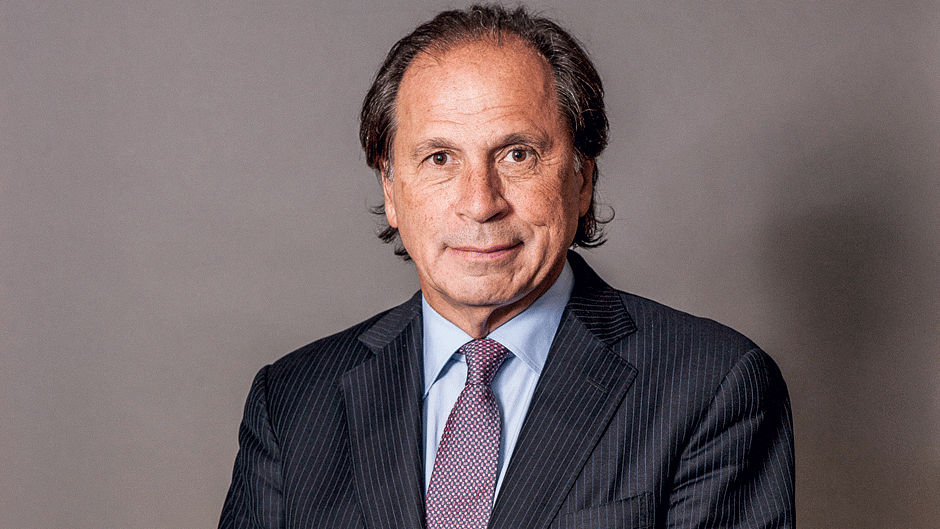


When Benjamin Steinbruch took over the steel company CSN after it was privatized in the 1990s, it was losing the equivalent of US$ 1 million a day. Now the group is one of the biggest steel producers in Latin America, operates ports and railroads, and is Brazil´s second-largest exporter of iron ore. Steinbruch is a friend of President Dilma Rousseff´s Chief of Staff, Aloizio Mercadante, and has a seat reserved at all the government´s meetings with the sector. In April last year, he wrote an article for his column in the Folha de S.Paulo newspaper headlined “Get lost, Doom and Gloom!” He said in the article that critics of Rousseff´s government were only “seeing the negative side of the world”. In this interview, Steinbruch, the current chairman of Fiesp, explains why he has changed his mind.
You said that “only someone who is crazy would invest in Brazil”. So what are the ones like you who are not crazy doing?
This phrase has had a great impact because it highlights what everybody would like to say but nobody does. I am the craziest of all. CSN will invest R$ 6.5 billion next year alone but if the conditions were good, we would obviously be investing a lot more. Brazil is currently an expensive country. When you compare the cost of doing business in Brazil with any other country, it is at least twice as much here.
Until recently, you were a businessman who was close to the government. What has led you to distance yourself from it?
It is not a question of being close or not. We are experiencing a situation in which we have been trying to talk to the government for a long time to warn it about the problems in a number of sectors. These discussions have been very difficult. The government has not been listening to the business leaders´ warnings.
What are the main warnings?
There are many. We are constricted by labor laws dating from the time of the former president Getúlio Vargas (in the middle of last century). We need to update this model and make it more flexible to give the employer and employee more agility. There could be shorter hiring periods, for example, and more flexible working hours. The social charges for the employee alone cost double the actual wage. You have to think very carefully if you are going to hire someone nowadays. The cost of dismissing workers is also very high and, on top of all this, there is the absurd tax burden.





But every time the business leaders complain about the tax burden, the government responds by saying it has given exemptions.
Yes, it has given exemptions. However, on the other hand the regulatory agencies are imposing incredible fines – in the telecommunications sector, electrical energy sector, for example. The Federal Revenue also penalizes companies in a brutal way.
Is the government giving with one hand and taking away with another?
The government gives with a finger but grabs what it wants with both hands. The exemption argument has one effect but the impact from the penalties imposed by the regulatory agencies and the tax authorities is much bigger. This does not only upset business leaders in Brazil but creates great unease among foreign investors. The agencies should regulate in a transparent way that makes all the parties feel at ease. Nobody believes this is the case today.
The decree that taxed the profit of Brazilian companies abroad has also been the target of a lot of complaints.
Of course. This decree would create an enormous liability for companies. However, the government then approved a tax system (known locally as the Refis that allows outstanding corporate tax bills to be paid in installments) for the companies that would be affected. In other words, it created an enormous problem which scared the business leaders and then removed it and the business leaders were relieved. However, all this left a bad taste in the mouth. These situations discourage investment and lead to enormous instability and even greater mistrust. They create uncertainty and ill will.
Is this what explains business leaders´ hesitation in investing in Brazil?
It is this lack of security in relation to the future. Every country has an investment plan covering 20 years: China, Japan, South Korea. Brazil does not. Or at least we don´t know about it. This is because so many stopgap measures are taken on a daily basis that they end up distorting the bigger plan. If you ask people what Brazil´s current industrial policy is, I doubt they would know how to answer. We are also undergoing an absurd process of deindustrialization. Manufacturing industry´s share of GDP has fallen from 25% to 12.5% over the last 25 years. This is not just a businessman complaining. These are the actual numbers that confirm this trend. How can you put up with such a shocking deindustrialization process in a continental-sized country like Brazil? Industry has been abandoned. It is no longer in intensive care but dying.
As a businessman, how do you assess the governments of Fernando Henrique Cardoso, Luiz Inácio Lula da Silva and Dilma Rousseff?
The Fernando Henrique Cardoso government was liberal and had a vision of reducing state participation in the economy. The state does not need to be a good manager, it just needs to be a regulator and check if policies are being followed. The stability of the Real allowed Brazil to grow. Then came the Lula government that took advantage of this good wave, and took a very positive decision not to go against the market. By doing so, it brought almost 40 million people into the consumption market who had previously been excluded. Combined with this, we hit it lucky with China´s growth and exported iron ore, meat, soybeans. The domestic and international markets were strong during the Lula government, a perfect combination. Lula knew how to take advantage of these two good moments and did a good job.
And President Rousseff?
President Rousseff did not find the same fortunate environment and adopted a more interventionist policy. I see her as being hard working and willing to get things right. However, she does not seem to have faith in the ability of Brazilian private initiative to assume its responsibilities and this leads her to put the state in a competitive position where it is not needed. As a result, she began to intervene in some sectors in a very determined way, distancing herself from contacts with the productive sector. Brazil remains the same, the business leaders remain the same and the opportunities remain the same. However, what is now lacking is confidence, proximity, convergence and determination.
Are business leaders disappointed?
They are feeling anxious. Everybody wants to help President Rousseff get things right. Now, she needs to allow herself to be helped and to benefit from this good will. However, there is this distancing. Brazil is still experiencing this good moment and is in a better position than some other countries. Nevertheless, the risk is that the economy is no longer growing by just 1% but shrinking.
What future do you foresee for Brazil if the current path is maintained?
The country is going to run straight into a wall if there is no change. Unemployment is knocking at the door, the economy is cooling, default is increasing and there is a lack of credit. The variables are all unfavorable and this is occurring in an electoral year. Normally, government eases up a bit on the economy in an electoral year so the employer, employee and even the government is satisfied, with its tax revenues. The opposite is happening today. If there are already big problems over job security in the present situation of almost full employment, imagine how it would be if there was unemployment. If the issue of the fiscal deficit exists with a heated economy, imagine what it would be like with a recession. This is the case for everything, such as education, health etc. We issued a warning: things are worsening, are becoming bad and there is a risk of unemployment. However, nothing happens. The measures that were taken, although positive, are stopgaps.
However, the employment figures are still high. Recent surveys show that the population is not worried about unemployment.
There has already been a move towards a fall in the number of jobs. The greatest concern today among the population is inflation and the government is putting a lot of effort into this because it knows it will lose the election if inflation runs out of control. However, the variables are not the right ones. The exchange rate and interest rates are causing much more damage to the economy than bringing benefits. When you freeze fuel prices, appreciate the currency or you raise interest rates too much, you start heading towards an unreal situation that will certainly not provide the solution for the country.
What could be done to improve the situation?
Interfere with the exchange rate. Reduce interest rates and, in turn, depreciate the Real, which would create a promising climate for exports. Some door needs to be opened because we do not have anywhere to go nowadays. The exchange rate was used as an instrument to combat inflation but all the indices are falling. I think a depreciation of 10% would work very well.
Instead of intervening in the exchange rate, one of the three prongs of economic stability, would it not be better if the government improved the conditions of competitiveness for Brazilian industry?
My suggestion is to let the currency float. It is currently being kept artificially low because the government wants to keep inflation under control through the exchange rate. If the currency is allowed to float, it will depreciate naturally.
You spoke about an “aggressive” solution for the problems. What would that be?
Carry out reforms. Regardless of who wins the election, he or she will have to do what it is necessary. If there are no immediate reforms after the election — political, fiscal, labor — the country will go nowhere. If you look at the budget, the numbers are very strong. We have money. The question is spending and investing this money well. The public sector machine does not need to grow. It needs to be reduced. The smaller, the better.
How do you regard the candidature of Marina Silva?
She is a very strong candidate. If she takes the right step at this moment, which is to nominate strong names for the Finance Ministry, the Development Ministry and the agribusiness sector, she will be in a very competitive position. If she were to bring in names like Roberto Rodrigues (former Agriculture minister), Henrique Meirelles (former Central Bank chairman), people who are recognized in Brazil and abroad, this would make her very strong. Marina Silva, like Eduardo Campos (the presidential candidate who was killed in an air crash in August and was succeeded by Marina Silva who was his running mate), sees the market as a producer of wealth. She has a very incisive social and environmental view but this is not a problem. The modern business world has to have also a strong social and environmental concern or it would not survive.
Are you not worried that a Marina Silva government would make it difficult to carry out infrastructure projects by refusing to grant environmental licenses?
No. Brazil needs to advance and a rational view of things has to be taken to do so. She has this view.
You have already assessed how Rousseff and Silva governments could be. What about Aécio Neves?
He has already shown that he was a good administrator as governor of Minas Gerais state because he knows how to delegate. He has a good working team and plays the role of a coordinator. He has a broad view of the world and knows Brazil. He has the conditions to run a great government. The candidate who will appeal most to me is the one with the proposal to make the widest ranging reforms. The opportunity of saving Brazil is in our hands.
EXAME magazine wrote that your fear is not to fail, miss the wrong target or lose market but to be let down. Is this so?
I do not think anybody likes to be let down but this is not my greatest fear because I have already been in this situation a number of times. We fall and then we get up again. There are things I want and have no fears apart from flying.








 ACESSO LIVRE COM VIVO FIBRA